Case Study: Evolving an Agency Website for Law-Firm Growth
How I contributed to an agency website's third design iteration, ongoing technical SEO and performance work, and a careful WordPress staging and maintenance workflow.
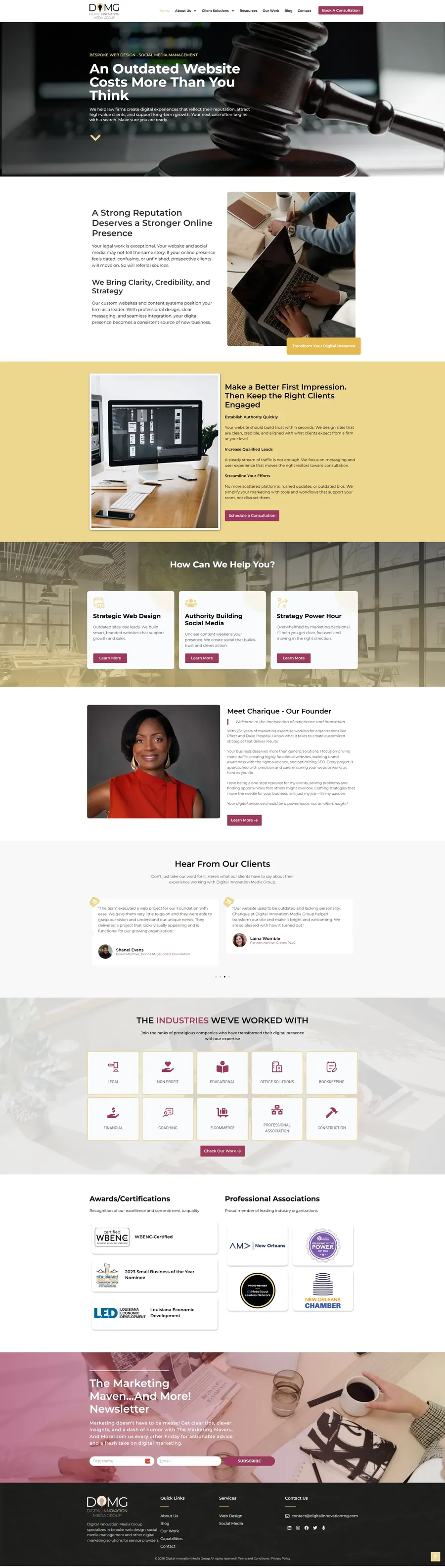
Project Snapshot
- Client
- Digital Innovation Media Group
- Services
- WordPress DevelopmentWebsite MaintenanceTechnical SEOPerformance Optimization
- Tech
- WordPressElementor ProTechnical SEOPerformance OptimizationCustom Development
The agency website is an active part of how the team presents its services and attracts new business. Its design and messaging evolve as the agency's focus changes, while the site needs to remain maintainable, dependable, and clear for prospective clients.
I work as the primary developer, implementing approved design direction, maintaining the WordPress site, and adding custom functionality when a project requires more than the standard builder controls. The agency's leadership provides the website content and project direction; I focus on development and technical implementation.
1. An Agency Website That Keeps Evolving
When I joined the agency in March 2023, its employer was managing the website. Since then, the site has gone through three design iterations:
- The original Elementor site: The starting point was built with WordPress and Elementor. As I took on more development work, I noticed opportunities to simplify sections and reduce unnecessary elements.
- The 2024 visual refresh: The team introduced a slanted-section design based on a mockup from the agency's design partner. I helped implement and refine that direction while keeping the page structure aligned with the approved design.
- The 2026 redesign: For the current iteration, I developed a new design direction of my own and implemented it for the agency site. The visual system follows the approved palette and typography, with responsive adjustments for tablet and mobile layouts.
The site now speaks more directly to the agency's current focus on law firms, while continuing to support its broader work and changing service priorities. That focus is still being refined as the agency updates its content and search strategy.
2. Design and Delivery Around an Approved Scope
The work begins with discovery and a clear understanding of the requested pages, audience, references, and scope. The agency prepares the content and project direction. Depending on the project, a teammate or design partner creates the mockup; we review the design together and collect client feedback before development begins.
For website projects, the team maps the site structure and agrees on the page flow. A desktop homepage mockup establishes the visual direction; I then carry that approved system through the remaining pages and adapt it for tablet and mobile. When a layout needs a breakpoint beyond standard responsive behavior, I use custom CSS.
We discuss changes in Slack and keep development tied to the agreed scope. This helps protect time for implementation and testing, and gives the client a chance to review the design before it becomes a working site.
3. WordPress Development and Practical Customization
The agency's website is built on WordPress with Elementor. My development work includes refining layouts, maintaining the site, and writing custom PHP, JavaScript, or CSS when a requirement is not well served by the builder's default controls.
That custom work is also part of my broader development role across agency projects. Depending on the project, I work with tools such as Elementor Pro, ACF, WooCommerce, SMTP, and automation platforms including Zapier and Make. I use custom templates and code where they provide a clearer editing experience or support a specific requirement, rather than adding plugins or complexity without a need.
The website's content and target services change over time, so ongoing updates are part of the work. The agency's leadership supplies the copy; I implement content and structural changes while keeping the page layout and technical setup consistent.
4. Backups, Staging, and Quality Checks
Before maintenance or significant updates, I create a recovery point. The site is hosted on Flywheel, where I use its backup tools and staging environment to review changes before pushing them live. If a fix requires server-level access, I use SSH where available.
The agency's typical delivery process also includes:
- Reviewing the proposal, requirements, and approved scope before development.
- Building and reviewing changes on staging before deployment.
- Testing layouts on desktop, tablet, and mobile devices.
- Checking links, forms, copy, responsiveness, speed, and accessibility.
- Taking a final backup and confirming launch readiness with the team.
- Providing a handoff guide or recorded walkthrough when a client needs help managing the site.
For email delivery, I configured SMTP for form messages to improve delivery reliability and reduce spam problems. The contact form worked before this change; the goal was to strengthen the delivery path, not to claim that it had previously failed.
5. Ongoing Technical SEO and Performance Work
The current focus is improving search visibility and technical performance. Work includes page-level metadata, internal links, image optimization and alt text, semantic structure, and technical items such as schema, robots.txt, llms.txt, and the sitemap where appropriate.
Performance work is ongoing. The homepage uses a background video, which makes the above-the-fold experience and Largest Contentful Paint an area I am still investigating. I am testing loading priorities and reducing unnecessary animation and page weight, while checking results across devices and performance tools.
I am also evaluating a move from the current OceanWP setup to Hello Elementor as a lighter foundation. That migration has not been completed. A custom theme and a possible headless WordPress approach are longer-term ideas, not shipped features; any change would need to make sense for the site's needs, maintenance, and available budget.
6. Results and What Remains in Progress
The current site reflects a clearer, updated design direction and a development process built around backups, staging, and responsive review. Technical SEO and page-speed improvements are active work rather than a finished campaign.
I do not have permission to publish agency analytics or client performance data, so this case study does not claim specific ranking, traffic, conversion, or speed increases. Instead, it documents the development practices and current improvements that can be described without exposing confidential client information.
Technical Stack and Practices
- Platform: WordPress and Elementor
- Development: Custom PHP, JavaScript, and CSS when required
- Hosting workflow: Flywheel backups and staging; SSH for necessary server-level fixes
- SEO and performance: Metadata, internal linking, image optimization, semantic structure, and ongoing page-speed work
- Quality checks: Responsive, link, form, copy, performance, and accessibility review
Need a Website Built Around Your Business?
- Schedule a Direct 30-Minute Discovery Call: Book via Calendly
- Get in Touch Directly: Visit the Contact Section
Work With Me
Want Results Like This for Your Organization?
Tell me about your platform and I'll outline the fastest path to a website that loads quickly, ranks well and turns visitors into inquiries.
Related Reading
Website Developer for Builders and HVAC Companies: What Your Site Needs to Bring in Leads
A web developer who builds for builders and HVAC companies explains what a site needs: speed, clear structure, forms that deliver, an easy project gallery and lead filtering.
Why Slow Construction Websites Lose Multi-Million Dollar Bids (And How Modern Web Architecture Solves It)
Discover why bloated page builders, heavy hero sliders, and raw visual assets cost builders high-value contracts—and how custom web engineering delivers sub-second speeds.
Case Study: Bryvium AreaPulse, a WordPress ZIP Code Checker for Service Areas
How I built AreaPulse, a WordPress ZIP code checker that sorts visitors into Qualified, Coming Soon, or Not Available before the form. No geocoding API needed.